
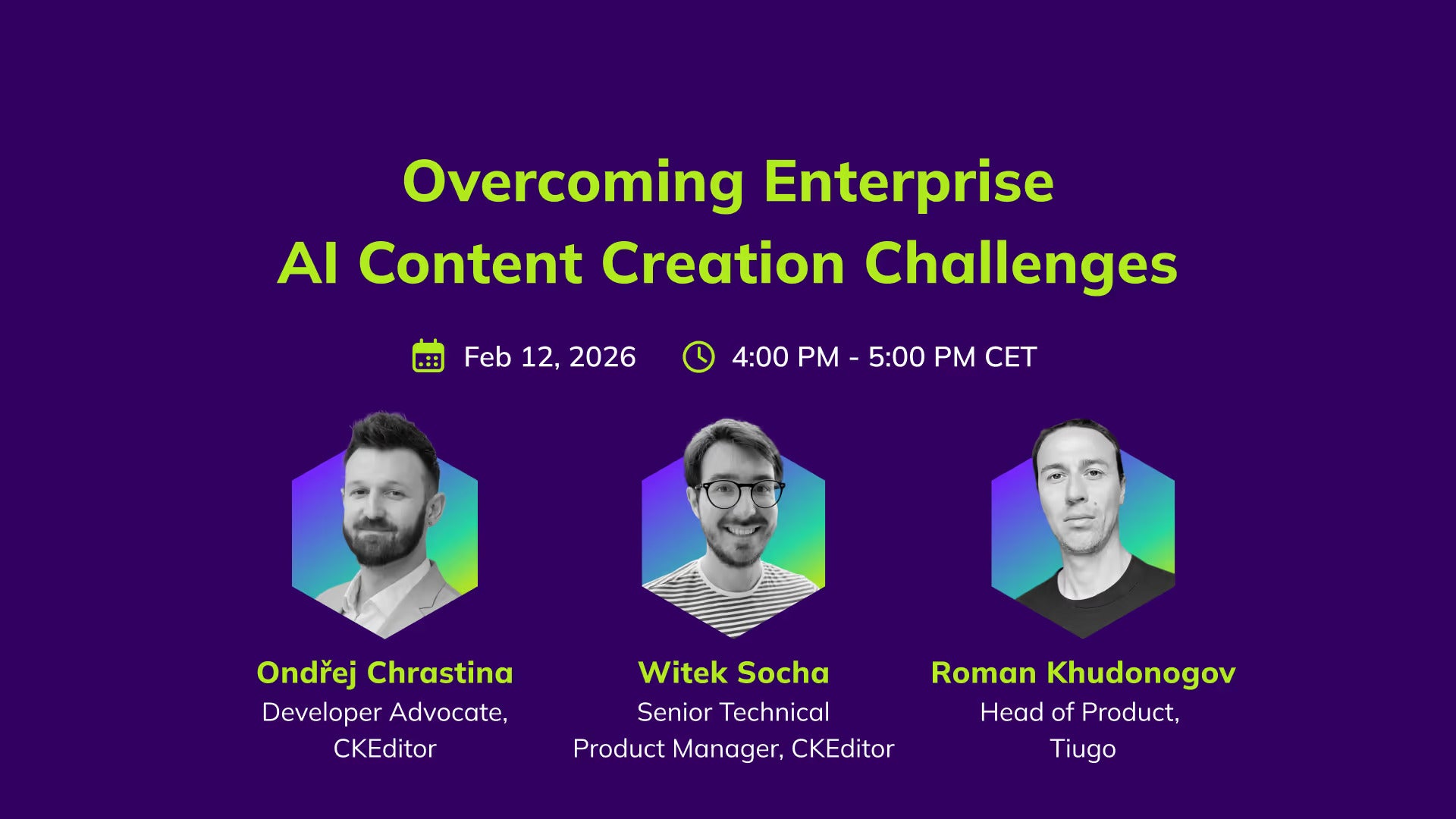
Roman Khudonogov and Witek Socha unpacked the four enterprise gaps we keep seeing in AI content creation — urgency, trust, breadth-vs-depth, and API-vs-flows — and what it actually takes to bridge them in production.
Released: Thu Feb 12 2026
What the session covered
I bet most of you have copy-pasted a paragraph from ChatGPT into your business app this week. That's the broken workflow we keep seeing in the wild — and the data backs it up: roughly 40% of work-related AI messages are writing tasks. Standalone tools cost you context, security, and time. Embedded AI wins. This session was about why, and what gets in the way at enterprise scale.
The four enterprise gaps
Roman and Witek broke down the patterns they keep hearing in customer conversations:
- Urgency vs. strategy — speed pressure clashing with long-term planning.
- Trust — compliance, security, and data residency reality checks.
- Breadth vs. depth — generic AI versus domain-specific behavior.
- API vs. flows — model calls versus full production workflows.
From there they dug into why applying AI to real documents is hard: evaluations, context windows, permissions, and where MCP fits into the backend complexity.
Who it was for
CIOs, CTOs, engineering managers, technical leads, product managers, AI architects, and engineering teams building AI-powered content experiences that need to be secure, scalable, and compliant.
Chapters
- 00:00 — Introduction & speaker introductions
- 02:18 — CKEditor AI recap: features & demo
- 04:23 — Why GenAI matters for writing (Roman Khudonogov)
- 09:17 — The broken workflow: copy-paste between apps
- 12:29 — Key takeaway: embed AI to eliminate friction
- 16:02 — Enterprise AI gaps: patterns from customer conversations (Witek Socha)
- 24:35 — Why applying AI to real documents is hard
- 26:02 — Backend complexity: evaluations, context, permissions & MCP
- 30:05 — Q&A